Today we sit down with Shaun Opoku, a founder and visionary who has successfully scaled and exited a seven-figure business and is now pioneering what he calls a “conflict-free” model in the prop trading world with his latest venture, PropFunding.com.
Opoku’s story goes beyond launching businesses. It’s centered on transforming entire systems from their foundations. His journey from the risk desks of traditional finance, where he witnessed a deeply ingrained “us vs. them” mentality, to founding PropFunding.com is a case study in turning personal conviction into a scalable business model.
In this conversation, we’ll dive into how he identifies foundational opportunities, why he invests in “unsexy” sectors, like agriculture and water, and how he’s leveraging data not just to manage risk, but to create a truly fair and self-improving ecosystem for traders.
In your own words, what is the essential thread that connects you, your background and the vision for your ventures? What’s the core message you’d want us to take away?
Shaun Opoku: There’s a quote I live by: “Everything you want in life is on the other side of fear.” To me, that’s more than motivation; it’s a framework for building. Every company that truly breaks through is born from someone willing to think differently, to take the harder route when the easy one is crowded.
In every venture I’ve launched, I’ve found myself as the underdog, and I’ve learned to embrace that. Being underestimated forces creativity. It demands resilience. Back in late 2021, for example, we launched instant funding under our retail arm, Traders Central Fund (TCF). At that time, the idea seemed almost absurd, as the industry was fixated on two-step challenges and the necessary infrastructure simply didn’t exist. We had to build risk systems from scratch and navigate a landscape with no playbook. It was grueling, but it taught us everything about innovation under pressure.
Today, instant funding is everywhere. What once looked risky now feels like the obvious choice. That experience shaped how I approach every new venture: If it feels uncomfortable, it’s probably worth doing.
Your work emphasizes “conflict-free” financial models and “alignment, not conflict.” This suggests you identified a fundamental flaw in traditional finance. What specific personal experience or observation in your trading career convinced you that the prevailing “us vs. them” model was inefficient or unscalable?
Shaun Opoku: Earlier in my career, I worked on the risk desk at a firm providing liquidity to several prop companies. On the surface, it looked like a well-oiled operation; firms would send over a portion of the challenge fees, and in return, we’d manage the payout and risk exposure for their funded traders. But behind the screens, it was a different story.
Each risk manager had a “pass quota,” a fixed number of traders we were allowed to let through, regardless of performance. I still remember watching traders who had followed every rule, hit every target, and yet were rejected for reasons we had to invent. When I questioned it, the COO told me, “If you want to be nice and fair, go work in an ice-cream shop.” That moment stuck with me, not because it was cruel, but because it was so normalized. It exposed the misalignment of incentives between firms and traders.
And that wasn’t an isolated case. There have been instances where liquidity providers have forced us to close our clients’ trades, alter margin requirements overnight and move the goalposts when exposure ran too high. The entire structure was built on opacity, where “the house” always won, even if it meant breaking its own rules.
That experience shaped the foundation for PropFunding.com. Our mission is to prove that a conflict-free model, which isn’t only ethical but also scalable, is possible. We’re building full transparency into every layer: Real-time leaderboards showing who’s competing, public ecosystem stats and soon, a payout pool tracker detailing every inflow and outflow. Our goal is to create a system that allows traders to see what’s happening behind the scenes.
Founders often build what they needed but couldn’t find. If you could go back in time and give your younger, prop-desk-self access to PropFunding.com, what single feature or term of the agreement would have most dramatically accelerated your own growth and success?
Shaun Opoku: If I could go back in time, the one thing I’d want from a firm is honesty. Just be upfront about how the system actually works. Back then, most firms would claim, “We A-book traders” or “We sell trading data to hedge funds,” but almost none of it was true. That lack of transparency created a culture of uncertainty, marked by vague rules, unclear risk parameters and constant anxiety about what might disqualify you next.
It wasn’t just about losing trades. It was about losing trust. Every payout request felt like walking on eggshells, hoping the firm wouldn’t invent a reason to deny it. That kind of stress makes consistent profitability nearly impossible.
If I’d had access to a model like PropFunding.com, one that’s upfront about how it works, where traders can see exactly what drives payouts, how the ecosystem functions and what the rules actually mean, it would have changed everything. It removes the second-guessing and fear, replacing them with what every trader really needs, which is clarity and confidence.
You’ve successfully scaled and exited a seven-figure business. Many people focus on scaling revenue, but you talk about scaling systems. What is a non-financial metric or a system-health indicator you look at to know a venture is truly scaling in a sustainable way?
Shaun Opoku: For me, the real indicator of sustainable growth isn’t revenue, it’s system resilience. You only know how strong your operation truly is when you start dogfooding your own product at scale.
At Traders Central Fund, I remember the turning point vividly. We were averaging around 700 new sign-ups a day, and things would break in ways we couldn’t have predicted. Our servers would crash, payment systems would jam, and we quickly learned that every level of growth exposed a new weakness. At one point, we had to migrate from self-hosting to AWS with autoscaling just to keep up with demand.
Then there were the operational hurdles, such as maintaining our banking relationships. Prop trading was still a gray area, at the time, and banks didn’t know how to categorize us. I recall meeting our relationship manager in person, armed with a deck that explained every detail of our process, to justify why we were sending so many wires to so many people. Remember, this was before platforms, like Deel or Rise, existed to make global payouts seamless.
That experience taught me that scale without stability is chaos. At PropFunding.com, we’ve taken those lessons to heart. We’re intentionally starting with smaller account sizes and capped monthly entry slots, ensuring that every layer, from the tech to the payout systems, can handle stress before we expand. We already know the demand for our model is there; our cohorts sell out in minutes every month. But the goal isn’t speed, it’s endurance.
Building businesses across Africa and in global fintech requires navigating distinct markets. What is a unique insight or a “structural arbitrage” opportunity you’ve identified in African markets (e.g., in agriculture, fintech) that the traditional Western investment world consistently overlooks or misunderstands?
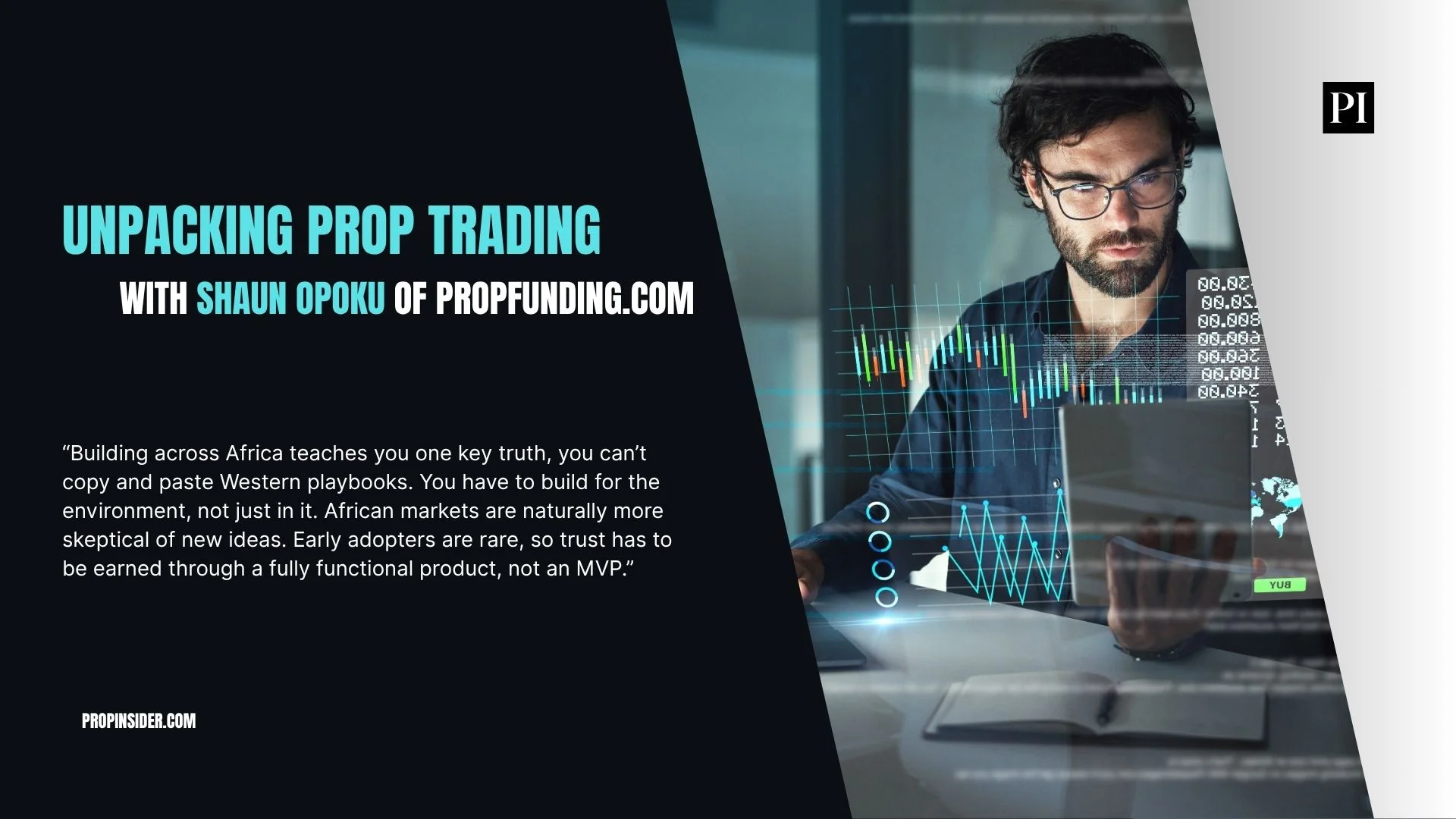
Shaun Opoku: Building across Africa teaches you one key truth: You can’t copy and paste Western playbooks. You have to build for the environment, not just in it. African markets are naturally more skeptical of new ideas. Early adopters are rare, so trust has to be earned through a fully functional product, not an MVP. You launch with something that works, not something you’re still testing.
In fintech, one of the biggest structural opportunities lies in stablecoins. While most apps focus on remittances, the deeper problem is inflation. Many local currencies lose value fast, and banks act as gatekeepers, blocking capital flight into USD.
A stablecoin network built specifically for Africa, one that lets users swap local currency for a USD-pegged asset while earning a share of the net interest margin, could be transformative.
Your investment portfolio includes technology, but also fundamental sectors, like agriculture and water production. This seems very intentional. Does your trading background, with its focus on signal vs. noise, influence how you identify these “first-principle” investment opportunities that fall outside the realm of what’s considered a “hot” sector?
Shaun Opoku: Absolutely. I’ve always believed the “unsexy” industries are where the real opportunities lie. When everyone’s chasing the next big thing, I’d rather focus on the sectors that quietly sustain entire economies: Agriculture, logistics, water and real estate.
My trading background definitely shaped that perspective. In trading, you learn to separate signal from noise, looking past hype and focusing on what actually holds intrinsic value. That mindset translates directly to investing.
I also see these sectors as a hedge. Finance and fintech are naturally high-risk, high-reward spaces. By investing in essential industries, I’m effectively preserving the gains from the financial markets’ musical chairs, turning volatility into something stable and enduring.
PropFunding.com is “data-powered.” Beyond risk management, how are you leveraging this trader data to create a feedback loop that actively improves the trader’s performance and your platform’s value? Is the data itself becoming a product?
Shaun Opoku: At PropFunding.com, the data is the product. Our model is built on identifying trader behavior patterns that generate alpha, not just for us, but also for the traders themselves.
That data directly shapes how we design our prop trading products. For example, we delisted pairs, such as gold, indices and select FX minors in Stage 1, because their volatility made them nearly impossible to monetize. Doing so reduced daily liquidations and helped traders focus on more stable, predictable pairs, improving results naturally without heavy intervention.
This creates a self-reinforcing loop: The more traders interact with the system, the smarter and fairer it becomes. Our pay-later model also gives 90% of traders who don’t pass right away a chance to keep practicing without losing money on repeated fees.
In the long run, the dream would be to reward traders with cash back once they pass their challenge, rather than requiring them to pay after they pass, essentially flipping the traditional model entirely.
The no-upfront-fee model is a brilliant acquisition tool. But retention is key. Walk me through the specific incentive structures you’ve built after a trader is funded to ensure they don’t just hit a target and leave, but become a long-term, profitable partner for the firm.
Shaun Opoku: Retention hasn’t really been a challenge for us; if anything, the opposite. Most traders who join a cohort and don’t pass end up re-enrolling in the next one. The no-upfront-fee model creates a natural cycle of engagement, allowing traders to continually improve without the financial pressure of constant re-entry.
Our focus now is on deepening that relationship beyond the challenge stage. We’re developing a community copy-trading platform, set to launch in mid-2026, which will enable traders to tap into our data monetization strategies without incurring a profit share. It’s another way to keep traders connected to the ecosystem , not just as participants, but as long-term collaborators in value creation.
If there’s a real challenge today, it’s keeping up with demand. Cohorts continue to sell out within minutes, so we’re preparing for a funding round in early 2026 to expand capacity and introduce larger account sizes.
With the exits and launches under your belt, the “what’s next” is always intriguing. What is a problem or a project that feels personally compelling to you now, the kind that might keep you up at night not with stress, but with excitement?
Shaun Opoku: Right now, my focus is entirely on PropFunding.com. I’m obsessed with proving that our model, one that removes upfront fees and aligns incentives, can become the new standard in prop trading.
What keeps me up at night isn’t stress; it’s possibility. I envision a day when traders have collectively saved millions in fees, withdrawn millions in payouts, and our data-driven strategies have generated millions in alpha to sustain the ecosystem.
Until we reach that milestone, I’m not chasing anything else. The mission is clear: Build a model that makes fairness scalable and prove it can win.
Disclaimer: The content presented herein is for informational purposes only. While efforts have been made to ensure the accuracy of the information, no guarantees are made regarding its completeness, reliability or suitability for any particular purpose. Before making any financial decisions, we strongly advise seeking guidance from a qualified professional.