

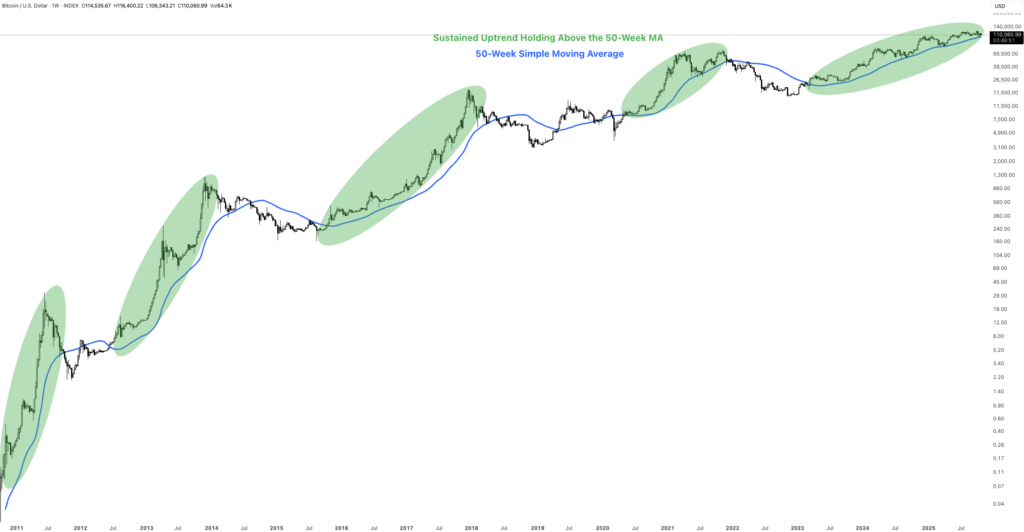
Bitcoin (BTC) has always followed a simple rule. When it trades above the 50-week moving average, the trend remains intact. When it closes two consecutive weeks below it, the cycle usually shifts into a bear market.
At the moment, Bitcoin is sitting at a critical point. The structure resembles both a Wyckoff reaccumulation and a Wyckoff distribution pattern.
On the chart, these are represented by purple and black/grey outlines. Both patterns are almost identical in their early phases, which is why the distinction can only be confirmed after price action plays out.
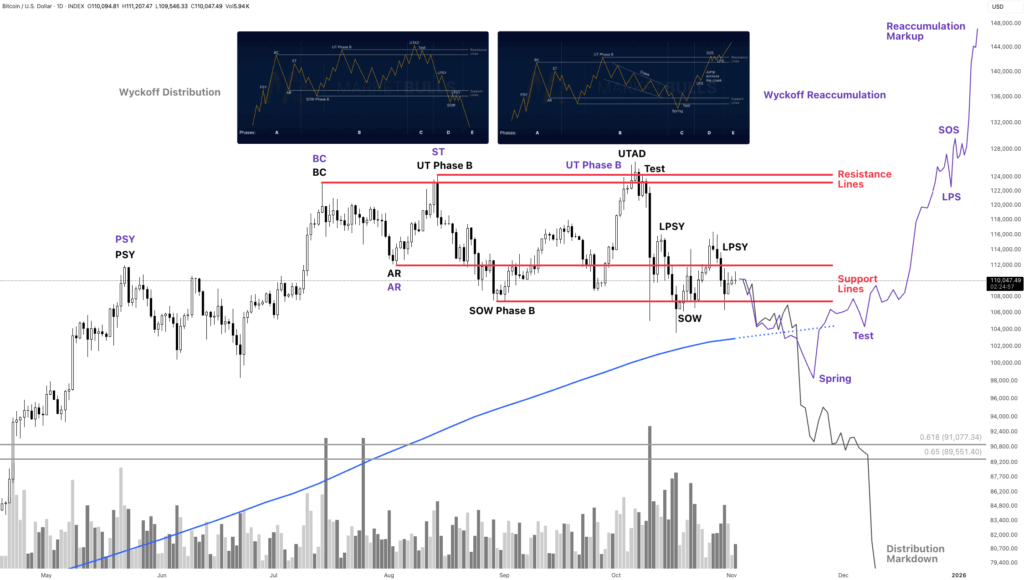
As long as Bitcoin holds the 50-week moving average, the uptrend remains valid. Historically, Bitcoin tends to top out in Q4 of post-halving years, either in November or December, which supports the case that the market is still in a Wyckoff reaccumulation phase. In that scenario, the purple trajectory suggests price could continue trending upward through late 2025.
Read More: SOL Price Prediction: Solana Approaches Wyckoff Breakout Phase With $400 in Sight
If Bitcoin breaks below the 50-week moving average, it could still technically remain in reaccumulation. However, if it stays below that level for two consecutive weeks, it would confirm a transition into Wyckoff distribution, signaling a more prolonged correction.
In both cases, we expect Bitcoin to move lower in the short term, completing either the final stage of distribution or the spring of reaccumulation before the next major move begins.
The Death Cross Factor
Another key development is the upcoming death cross, when the 50-day and 200-day moving averages intersect. For most assets, this crossover marks the start of prolonged declines. Bitcoin, however, behaves differently.
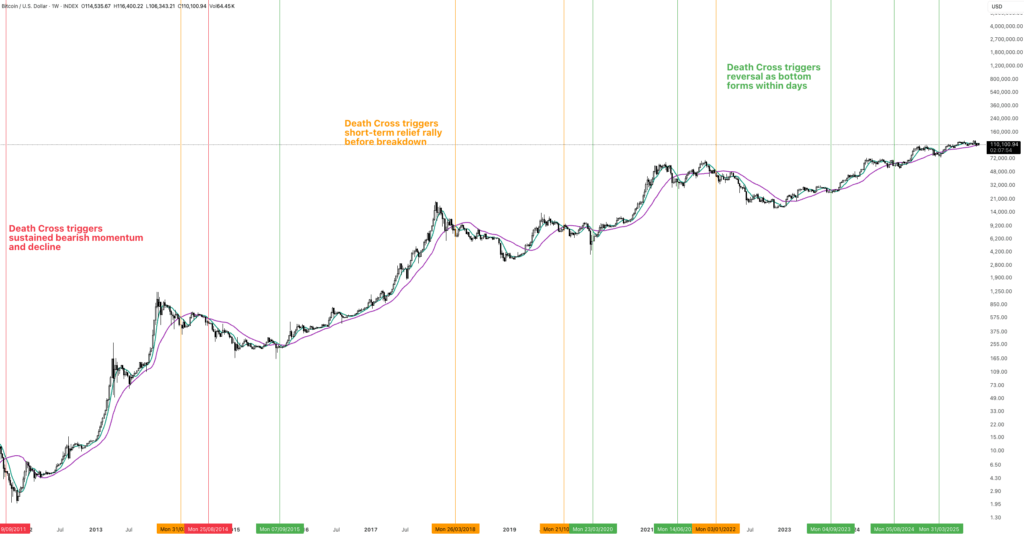
Since 2011, Bitcoin has experienced 12 death crosses. Only 2 of them led to sustained downtrends. In four cases, the cross produced a lower high before another drop, and in six, it marked the exact bottom. Statistically, that means that in 10 out of 12 instances (83.3%), Bitcoin moved higher either shortly after or directly following the crossover.
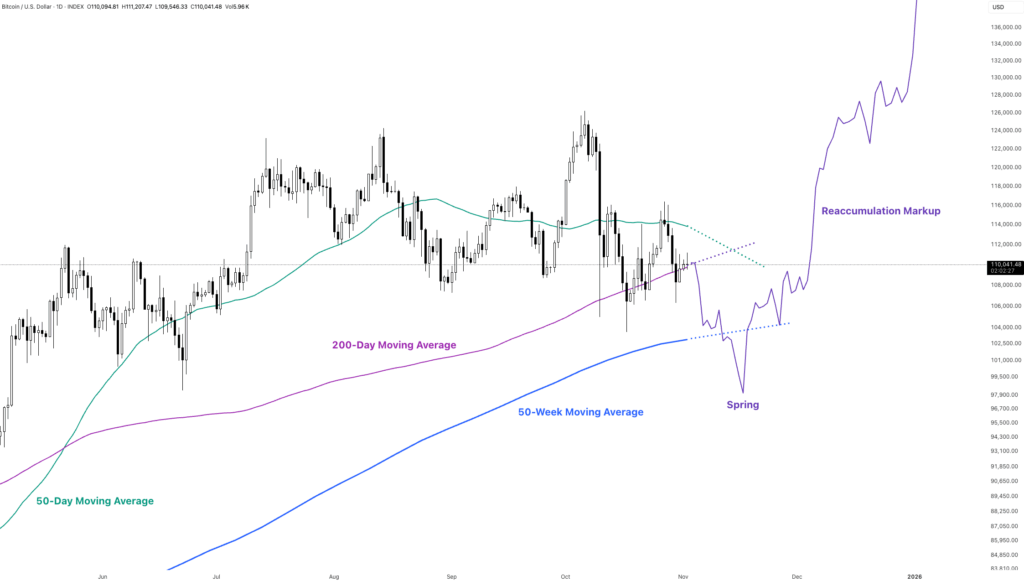
The next death cross is projected between Nov. 14 and Nov. 23, 2025. Historically, Bitcoin bottoms within one to three days before or after the cross, meaning this could coincide with the spring phase of Wyckoff reaccumulation.
When we combine that with the fact that Q4 in post-halving years has almost always been bullish, the probabilities lean toward this being reaccumulation, not distribution. In this case, the market would likely experience a sharp panic-driven selloff below $100,000, possibly near $98,000, before recovering.
Trade Scenarios
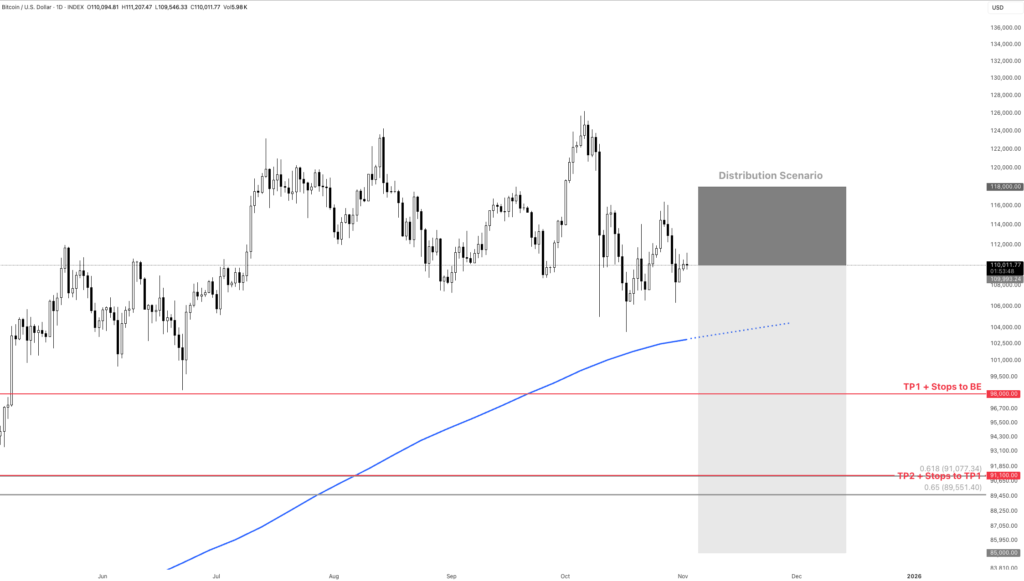
Scenario 1: Distribution Setup
Entry: Short between $107,000–$114,000
Stop Loss: $118,000 (allowing for a liquidity sweep above the recent high)
Take Profit 1: $98,000, then move stop to breakeven
Take Profit 2: $91,100, aligned with the 0.618–0.65 Fibonacci zone of the Wyckoff structure (from May 2025 low to October 2025 high)
Risk-to-Reward: Approximately 2:1, depending on entry
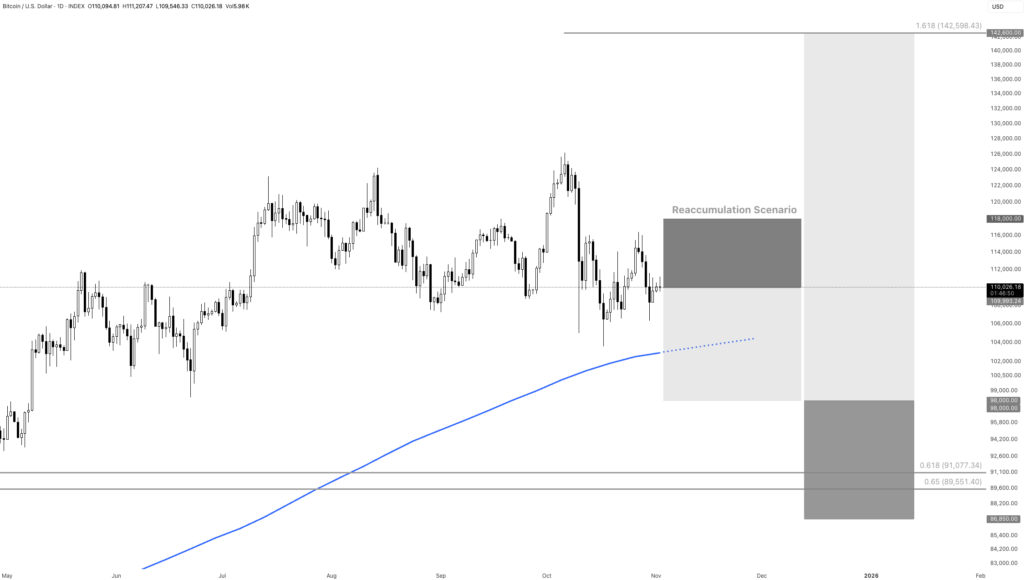
Scenario 2: Reaccumulation Setup
Short Entry: Same range as Scenario 1 ($107,000–$114,000)
Stop Loss: $118,000
Take Profit 1 (for the short): $98,000, then set a limit long at $98,000
Long Stop Loss: Below $86,850, just under the golden pocket
Long Take Profit: $142,600, corresponding to the 1.618 Fibonacci extension from October’s high to low
Risk-to-Reward: Short around 1.5:1, long around 4:1
Read More: Gold Price Prediction: Gold May Be Reaching the End of Its Parabolic Cycle
Disclaimer: The content presented herein is for informational purposes only and should not be interpreted as financial or investment advice. While efforts have been made to ensure the accuracy of the information, no guarantees are made regarding its completeness, reliability or suitability for any particular purpose. Financial markets carry inherent risks, and historical trends do not ensure future outcomes. Before making any financial decisions, we strongly advise seeking guidance from a qualified professional. The authors and publishers disclaim any liability for actions taken based on the information provided.