Starting a prop firm challenge can feel exciting.
You receive a large trading account, see a profit target and immediately want to start trading. However, the aim is not simply to make money as quickly as possible.
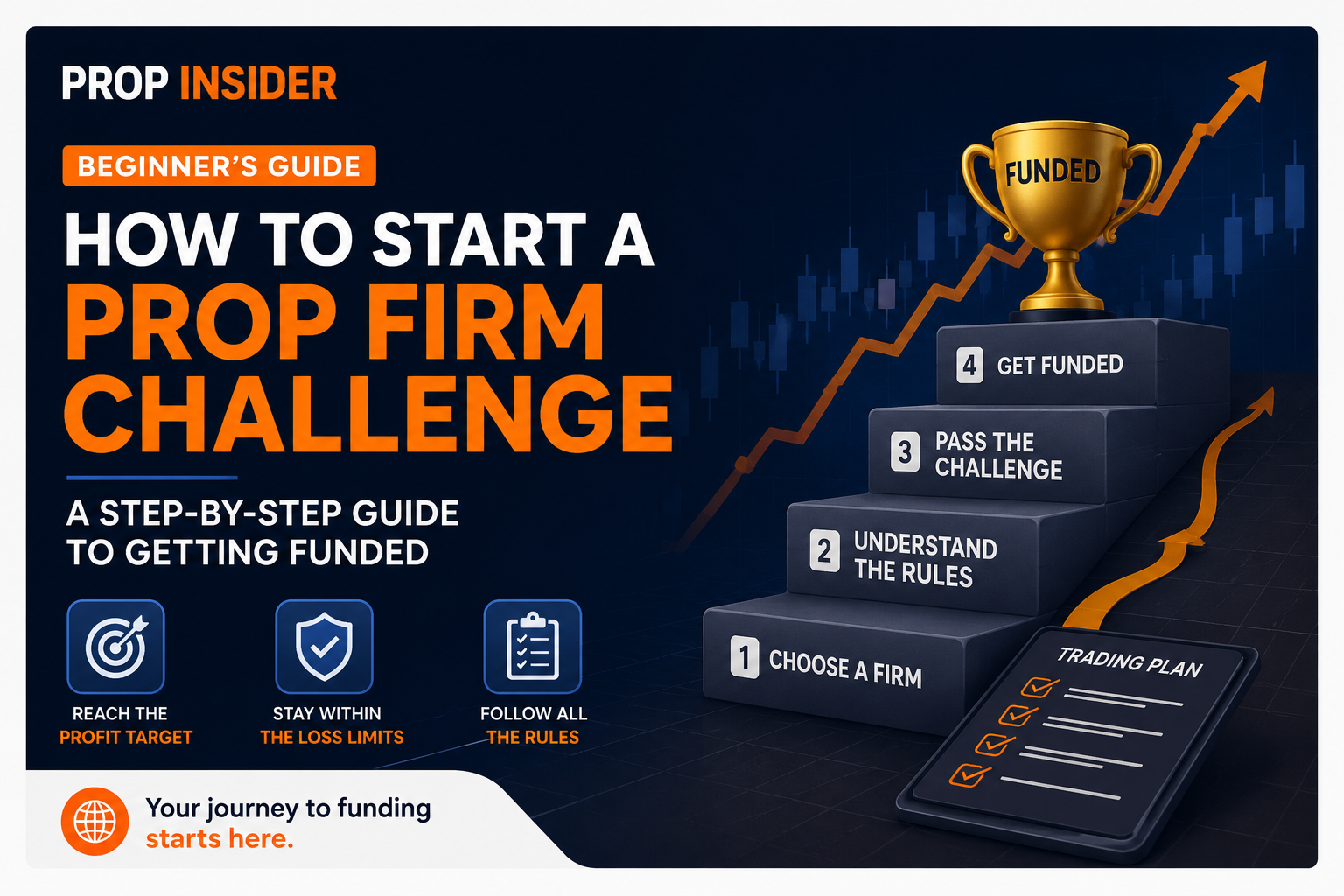
You normally need to do three things:
Reach the profit target.
Stay within the loss limits.
Follow all the firm’s trading rules.
A trader can make several good trades and still fail a challenge by breaking one rule.
Before placing your first trade, read the firm’s official rules carefully. Pay particular attention to:
- The maximum daily loss.
- The maximum total loss.
- Any consistency or minimum trading-day rules.
These rules are not the same at every prop firm. They can also be calculated differently.
This guide explains five important parts of trading a prop firm account:
- How to place a trade.
- How to choose your position size.
- How to use a stop loss.
- How to set a take profit.
- How to manage your overall risk.
Part 1: How to Place Your First Trade
The exact buttons may look different on cTrader, MetaTrader 5 or another trading platform.
However, the basic information required to place a trade is normally the same.
You must decide:
- What you want to trade.
- Whether you want to buy or sell.
- How much you want to trade.
You should also know where you will exit if the trade loses and where you may take your profit.
Step 1: Select the correct market
The first step is to select the symbol you want to trade.
Examples include:
- XAU/USD for gold.
- EUR/USD for the euro against the US dollar.
- US100 for a major US technology index.
Symbol names are not always identical across brokers. Gold may appear as XAUUSD, GOLD or another similar name.
Always check that you have selected the correct market before placing the order.
Step 2: Choose whether to buy or sell
You buy when you believe the price may rise.
You sell when you believe the price may fall.
These may also be described as:
- Buy or long.
- Sell or short.
Do not press buy or sell simply because the market is moving quickly.
You should already know why you are entering the trade and what would prove your idea wrong.
Step 3: Choose the order type
There are two main ways to enter a trade.
A market order opens the trade at the best available price at that time.
A pending order waits until the market reaches a price you selected.
A market order may be useful when you want to enter immediately. A pending order may be useful when you only want to enter if the market reaches a particular level.
Step 4: Enter the correct lot size
Your lot size controls the size of the position.
A larger lot size can produce a larger profit, but it can also produce a much larger loss.
The correct lot size depends on:
- Your account size.
- The distance to your stop loss.
- The amount you are prepared to lose.
Do not choose a lot size simply because another trader uses it.
Use the Prop Insider Position Size Calculator before placing the trade.
Step 5: Add a stop loss
A stop loss is an instruction to close the trade if the market moves against you.
It helps prevent a small losing trade from becoming a much larger loss.
Both cTrader and MetaTrader 5 allow traders to attach a stop loss to a position. Their official documentation describes a stop loss as an instruction intended to limit a loss when the price moves in the wrong direction.
Your stop loss should be decided before you enter the trade.
Step 6: Add a take profit
A take profit is an instruction to close the trade when the market reaches your chosen profit level.
It helps you avoid making an emotional decision while the trade is open.
A take profit does not mean that the market will reach your target. It simply closes the position if the selected price is reached.
Check everything before confirming
Before pressing the final buy or sell button, check three things:
- Is this the correct symbol?
- Is the lot size correct?
- Are the stop loss and take profit correct?
A simple typing mistake can cause a serious loss.
For example, entering 1.00 lot instead of 0.10 lots makes the position ten times larger.
Can AI help you place a trade?
An AI tool can help you understand the rules and check your calculations.
You could give it:
- The official prop firm rules.
- Your account size and planned risk.
- Your entry and stop-loss prices.
You can then ask it to calculate the possible loss and check whether the trade fits within your limits.
For example:
I have a $100,000 prop firm challenge. The maximum daily loss is 5%, and the maximum total loss is 10%. I want to risk no more than 0.5% on this trade. My planned entry is [price], and my stop loss is [price]. Using the contract size shown on my platform, calculate the maximum position size. Show every step and state all assumptions.
AI should only be used as a checking tool.
It can make mistakes, misunderstand rules or use the wrong contract size. OpenAI advises users to verify important information because language models can produce confident but incorrect answers.
Always compare the answer with:
- The firm’s official rules.
- The symbol information on your platform.
- The Prop Insider position size calculator.
Never give an AI tool your trading password or account login details.
Part 2: How Position Sizing Works
Position sizing means deciding how large your trade should be.
It is one of the most important parts of risk management.
A good entry with the wrong position size can still fail your account.
Lot size is not the same as risk
Many beginners believe that a small-looking lot size must be safe.
That is not always true.
Your actual risk depends on:
- The size of the position.
- The distance to the stop loss.
- The value of each price movement.
A position of 0.50 lots with a close stop may risk less than 0.10 lots with a very wide stop.
This is why position size and stop-loss distance must be calculated together.
Start with the amount you can lose
Do not begin by asking:
How many lots should I trade?
Begin by asking:
How much am I prepared to lose if this trade is wrong?
For example, a trader with a $100,000 account may decide to risk 0.5% on one trade.
That would be:
$100,000 × 0.5% = $500
The position must then be sized so that the planned stop loss produces a loss of approximately $500.
A simple position-sizing method
The basic process has three steps:
- Decide your maximum cash risk.
- Decide where the stop loss must be.
- Calculate the position size that connects the two.
A simplified formula is:
Position size = Maximum cash risk ÷ Loss per lot at the stop loss
Suppose one lot would lose $1,000 if the stop were reached.
If your maximum risk is $500:
$500 ÷ $1,000 = 0.50 lots
CME Group’s trading education follows the same basic approach. It says a trader should know the stop location and the amount or percentage of the account they are prepared to risk before calculating the correct position size.
Position sizing for gold
Gold is normally shown as XAU/USD.
On many trading accounts, one standard lot of gold represents 100 ounces. However, you must not assume this is always the case.
The exact contract size is set in the symbol specifications provided by the broker or prop firm. Both MetaTrader 5 and cTrader provide symbol information showing details such as contract size, lot size and permitted trading volume.
Before trading gold, check:
- The number of ounces in one lot.
- The minimum lot size.
- The value of a $1 price movement.
You can read our full beginner guide here:
You can also calculate a suggested position here:
Position sizing for other markets
The same method applies to currencies, indices, oil and other symbols.
However, the contract values are different.
For example:
- A forex lot may represent a set number of currency units.
- An index may have its own value for each point.
- Oil may be measured using a contract linked to barrels.
MetaTrader’s official documentation notes that one lot represents the number of units shown in that instrument’s contract-size specification.
This means 0.10 lots of gold does not carry the same risk as:
- 0.10 lots of EUR/USD.
- 0.10 lots of an index.
- 0.10 lots of oil.
Calculate each symbol separately.
Do not size the trade around the profit target
A common mistake is to start with the challenge target.
A trader may think:
I need to make 8%, so I need to use a large position.
This reverses the correct process.
Your position should be based on what you can afford to lose, not what you hope to make.
The challenge target may take several trades to reach. That is normal.
Part 3: How to Use a Stop Loss
A stop loss is one of the most important controls on a prop firm account.
It defines where you will exit if your trade is wrong.
Without a stop loss, your possible loss may continue to grow as the market moves against you.
What does a stop loss do?
A stop loss sends an instruction to close your position when the market reaches a selected level.
For a buy trade, the stop is normally below the entry.
For a sell trade, the stop is normally above the entry.
The purpose is not to avoid every loss. Losses are a normal part of trading.
The purpose is to control the size of the loss.
Where should the stop loss go?
Your stop loss should be placed at a level that shows your original trade idea is no longer valid.
It should not be placed:
- At a random distance.
- Where normal price movement may easily reach it.
- Based only on the amount of profit you want.
CME Group advises that a stop should be placed at a logical level that shows when the trade idea is wrong, rather than at a random point.
Once you have selected the stop level, adjust the position size to fit your allowed risk.
Do not move the stop closer simply so that you can trade a larger lot size.
Understand the prop firm’s daily loss rule
Your personal stop loss must fit inside the firm’s account rules.
Some firms calculate daily loss using more than closed trades. They may also include:
- Open losses.
- Trading commissions.
- Overnight swap charges.
For example, FTMO states that its maximum daily loss calculation includes open positions, commissions and swaps. Its limits also reset according to a stated platform time rather than each trader’s local midnight.
Do not assume your firm uses the same calculation.
Read the exact definition provided by your firm.
Leave room below the firm’s limit
Suppose the daily loss limit is 5%.
That does not mean you should plan to lose the full 5%.
You need to leave room for:
- More than one losing trade.
- Floating losses on other positions.
- Fees, swaps and price slippage.
A trader who operates close to the maximum limit can fail after a small unexpected movement.
Create your own daily stop that is lower than the firm’s maximum.
A stop loss is not a guaranteed price
A stop loss is an instruction to close a trade once the selected level is reached.
During a fast-moving market, the final price may be worse than the level requested. This is often called slippage.
cTrader explains that once the stop level is reached, the position is closed at the best available market price.
Slippage can become more likely during:
- Major economic announcements.
- Sudden political or market news.
- Periods of low liquidity.
This is another reason to leave a safety buffer below the prop firm’s maximum loss limit.
Do not keep moving the stop away
A beginner may enter a trade with a $200 maximum loss.
When the market moves against the trade, the trader moves the stop further away. The planned $200 loss may then become $500 or $1,000.
This destroys the original risk calculation.
Only adjust a stop according to a rule that formed part of your trading plan before the trade was placed.
Do not move it because you are hoping that the market will turn around.
Part 4: How to Set a Take Profit
A take profit is the planned exit point for a winning trade.
It answers a simple question:
Where will I close the trade if the market moves in my favour?
Both cTrader and MetaTrader 5 allow traders to attach take-profit instructions to open positions.
Start with a realistic target
Your take profit should be based on your trading method.
It may be placed near:
- A previous market high or low.
- A support or resistance area.
- A target produced by your strategy.
Do not set the take profit simply because you need a certain amount to pass the challenge.
The market does not know your account target.
Understand risk and reward
Risk-to-reward compares the possible loss with the possible profit.
For example:
- You risk $100.
- You aim to make $200.
- The risk-to-reward ratio is 1:2.
This does not mean that every trade needs a 1:2 ratio.
A strategy with smaller winning trades may still work if it wins often enough. A strategy with larger targets may work with a lower win rate.
There is no universal risk-to-reward ratio that is correct for every trader. FTMO similarly states that it does not set one universal position-size or reward-to-risk limit for all traders, although traders must still remain within the firm’s risk objectives.
Do not make the target too ambitious
A take profit placed too far away may rarely be reached.
This can cause a winning trade to reverse and become a loss.
Before entering, ask:
- Is this target supported by my strategy?
- Is it realistic for this market?
- Is the possible reward worth the risk?
The answer should come from a trading plan, not excitement about passing the challenge.
Can AI help with a take profit?
AI can calculate and compare possible take-profit levels.
It can help you answer questions such as:
- What is the risk-to-reward ratio?
- How much would the trade make at the target?
- Could the profit create a consistency problem?
For example:
My entry price is [price], my stop loss is [price], and my planned take profit is [price]. My position size is [size]. Calculate the cash risk, possible profit and risk-to-reward ratio. Then compare the possible profit with the consistency rules pasted below. Use only the rules I provide and clearly state any missing information.
AI cannot know with certainty where the market will turn.
It should help with the calculation. It should not invent the trade idea.
Verify the result before placing the order.
Do not change the take profit out of greed
A trade may approach the planned take profit, but the trader then moves the target further away.
The trader hopes to make more money and pass the challenge in one trade.
The market then reverses, and the profit disappears.
Decide before entering whether you will:
- Close at one fixed target.
- Take some profit and leave some open.
- Trail the stop as the market moves.
Use the same method consistently rather than changing the plan while emotional.
Part 5: Basic Risk Management and Consistency Rules
Risk management is the process of protecting the account when trades do not work.
It is not only about using a stop loss.
It also controls:
- The amount risked on each trade.
- The total amount risked during the day.
- The relationship between different open positions.
A trader does not need to win every trade to pass a challenge.
The trader needs to avoid losses large enough to end the challenge.
Know your three main account limits
Before trading, write down:
- Your maximum loss on one trade.
- Your personal maximum loss for the day.
- The firm’s official maximum account loss.
Your personal limits should normally be lower than the prop firm’s limits.
This creates room for mistakes, slippage and unexpected market movement.
Keep the risk per trade manageable
There is no single percentage that is correct for every trader or every prop firm.
The position must fit:
- The account rules.
- Your trading strategy.
- The number of positions you may open.
CME Group’s risk-management material recommends deciding in advance how much of the account may be risked on one trade, how many positions may be held and the maximum total account exposure.
A smaller risk per trade allows you to survive more losing trades.
That matters because even a good strategy can experience a losing period.
Watch your total open risk
Opening three trades does not always mean you have three separate ideas.
For example, buying gold, selling the US dollar and buying another dollar-sensitive asset may expose the account to a similar market move.
If all three trades lose together, the total loss may be much larger than expected.
Before placing another position, calculate:
- The risk on the new trade.
- The risk on all open trades.
- The possible loss if they move together.
This is your total open risk.
Set a daily stopping point
A trader often makes poor decisions after several losses.
This may lead to:
- Increasing the lot size.
- Entering trades without a setup.
- Trying to win the money back immediately.
This behaviour is often called revenge trading.
Set a personal daily loss limit. Once it is reached, stop trading for the day.
The firm’s maximum daily loss is an account breach level. It should not be treated as your normal daily risk allowance.
Understand consistency rules
A consistency rule measures whether your profits came from a repeatable pattern or one unusually large day.
A common version compares your best trading day with your total profit.
The calculation may look like this:
Best day’s profit ÷ Total profit × 100
Suppose your best day produced $1,200.
If the firm has a 40% consistency limit, your total profit would need to be at least $3,000:
$1,200 ÷ $3,000 = 40%
If your total profit were only $2,000, the best day would represent 60% of the total.
That would not meet a 40% rule.
FundedNext, for example, currently describes a 40% rule for certain on-demand performance rewards. Under that arrangement, the trader’s best day must not exceed 40% of total profit when the reward is requested.
Consistency rules are not all the same
Do not assume every prop firm has a consistency rule.
Some firms or account types have no consistency requirement. Others apply one only during:
- The challenge.
- The funded stage.
- A payout request.
For example, FundedNext states that its Stellar Instant account has no consistency rule, while some of its other reward arrangements use one.
The result of breaking a consistency rule also differs.
Depending on the firm, you may need to continue trading, make more profit, wait longer for a payout or risk losing the account.
Read the rule and its consequences before buying the challenge.
Why do prop firms use consistency rules?
Consistency rules are generally intended to stop a trader from reaching the target through one oversized or unusually lucky trade.
They encourage traders to produce steadier results and avoid a “home run” approach. The5ers describes this type of rule as a way to prevent one quick win from representing too much of the trader’s overall performance.
However, the rule can catch out beginners who:
- Suddenly increase their lot size.
- Make most of their profit on one day.
- Do not check the rule before requesting a payout.
A profitable account is not automatically eligible for a payout.
It must also comply with the firm’s rules.
Keep your trade sizes consistent
You do not necessarily need to use exactly the same lot size on every trade.
Different trades may have different stop-loss distances.
The aim is to keep the amount of money at risk reasonably consistent.
For example, these two trades may carry similar risk:
- A larger position with a close stop.
- A smaller position with a wider stop.
The lot sizes are different, but the cash risk is similar.
That is more important than using the same number of lots every time.
Do not try to pass in one trade
Trying to pass a challenge in one or two trades normally requires a large amount of risk.
That creates three dangers:
- You may breach the daily loss limit.
- One loss may cause serious account damage.
- One large win may cause a consistency problem.
A prop firm challenge should test whether your method can operate within a set of rules.
Treat it as a risk-management exercise, not a race.
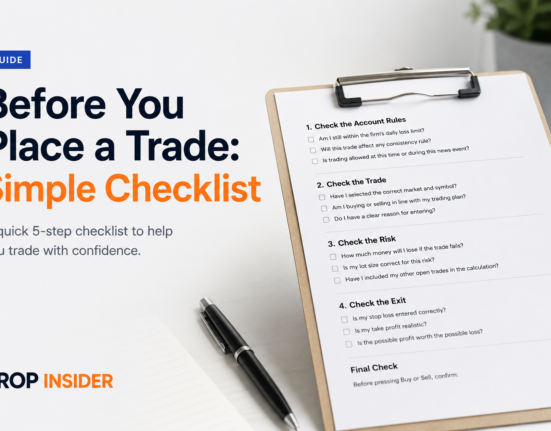
A Simple Checklist Before Every Trade
Before placing any trade, answer these three questions.
1. What happens if I am wrong?
Know the stop-loss price and the maximum cash loss.
2. Does the trade fit the rules?
Check the daily loss, total loss and consistency limits.
3. Is the position size correct?
Calculate it using the stop distance and the amount you are willing to lose.
If you cannot answer all three questions, do not place the trade yet.
Final Thoughts
Passing a prop firm challenge is not only about finding winning trades.
You must also show that you can control risk.
Remember three basic principles:
- Calculate the risk before entering.
- Use a stop loss and planned exit.
- Protect the account before chasing the target.
A trader who takes smaller, planned losses can continue trading.
A trader who risks too much may lose the challenge after one mistake.
Read the rules, calculate every position and keep your trading decisions consistent. The objective is not simply to get funded.
The objective is to stay funded.
This article is provided for general educational purposes and is not financial or investment advice. Prop firm rules differ and may change. Always check the current official terms for your chosen account before trading.