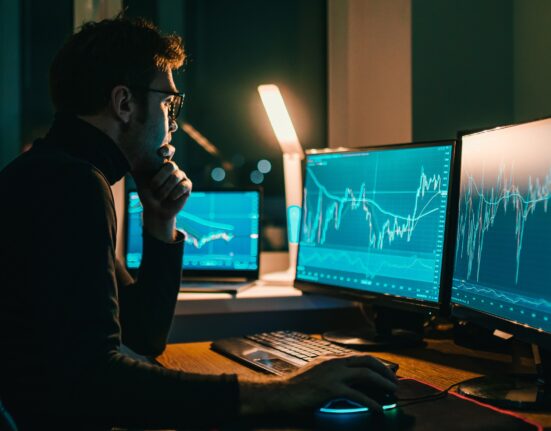






The clock blinks 2:17 a.m. The pale light of the monitor washes over a face tightened with focus. Another trade slips into the red, nudging dangerously close to the day’s loss limit. For the trader chasing a funded account in a prop firm challenge, the pressure can feel suffocating.
The dream of managing hundreds of thousands of dollars of someone else’s capital hovers just out of reach — so close it almost feels real. In this high-stakes environment, one question inevitably surfaces: In the age of artificial intelligence, is there a smarter way? Could an algorithm be the edge needed to finally crack the challenge?
Understanding the Battlefield: What is a Prop Challenge?
Before we deploy our digital tools, we must understand the terrain. A prop trading challenge, offered by firms, like FXIFY, Funded7 and others, is a rigorous evaluation. It’s not about getting lucky but about proving you can be consistently profitable and manage risk with discipline.
The hurdles are explicitly designed to weed out the unprepared:
- The Profit Target: A specific return you must achieve, typically 8% to 10%.
- The Maximum Drawdown: The absolute largest loss you’re allowed from your starting equity. This is the primary killer of challenge accounts. Breach it, and you’re out.
- Daily Loss Limits: A cap on losses for any single day, preventing desperate “revenge trading.”
- The Time Constraint: The pressure of achieving all this within a fixed window, often 30 days.
The goal is not to be a hero, but to be a consistent, risk-averse survivor.
AI Tools at Your Disposal
So, where can a tool that excels at pattern recognition and data processing fit into this process? In several powerful ways.
Strategy Generation & Ideation
Stuck in a creative rut? Large Language Models (LLMs), like ChatGPT or Claude, can act as a brainstorming partner. A prompt like, “Act as a quantitative analyst. Generate three mean-reversion trading strategies for the NASDAQ 100, complete with entry, stop-loss and profit-taking logic,” can yield a dozen starting points in seconds.
Read More: All-Time Payout Kings: Which Prop Firms Have Paid Traders the Most?
Similarly, AI-powered screeners can scan the entire market for chart patterns or unusual options flow that a human might miss.
Backtesting & Optimization
This is arguably AI’s most significant contribution. A human might backtest a strategy a few times with slight variations. AI can do it thousands of times, brute-forcing its way to an optimal setup.
- Automated Coding: AI can write, debug and optimize code for platforms, like TradingView or Python-based backtesters, saving immense time.
- Scenario Analysis: You can command an AI model to “Test this strategy’s performance during high-volatility periods, like March 2020 and the 2008 crash,” providing a brutal stress test.
- Risk Parameter Optimization: Crucially for challenges, AI can find the optimal stop-loss and take-profit levels that maximize profit while strictly minimizing drawdown.
Market Analysis & Sentiment Gauging
AI can process vast amounts of unstructured data in real-time.
Tools that scrape news wires, social media and central bank statements can provide a quantified “fear and greed” index, offering a second opinion on market mood that can help you avoid entering a trade right before a major news-driven reversal.
Trade Execution & Discipline
Emotions are a trader’s worst enemy. Using a pre-programmed trading bot to execute a vetted strategy eliminates hesitation and revenge trading. Furthermore, AI can analyze your trade journal, identifying behavioral flaws with cold, hard logic: “Your data shows an 80% probability of moving your stop-loss further away after a trade moves against you by 0.5%. These trades have a 95% failure rate.”
The Inherent Risks and Limitations: Why AI Isn’t a Guarantee
This is where the hype meets reality. Relying on AI without understanding its pitfalls is a surefire way to fail.
The Overfitting Trap (Curve-Fitting)
This is the single greatest danger. AI is spectacular at finding patterns in historical data, even random, meaningless ones. You can end up with a strategy that is perfectly optimized for the past but fails catastrophically in the live market.
Read More: How Much Do Funded Traders Really Make in 2025?
It’s like a student who memorizes the answers to a practice test but fails the real exam because the questions are phrased differently. The strategy looks brilliant in backtests but has no predictive power.
Data Bias and Black Swans
AI models are trained on historical data. They have no experience with truly unprecedented, high-volatility “Black Swan” events. The model that worked for the last five years might not account for the next financial crisis, a geopolitical shock or a flash crash — events that can vaporize a challenge account in minutes.
The Rule-Based Nature of Challenges
An AI might find a strategy with a 50% return and a 25% drawdown. By raw profitability, it’s a winner. In a prop challenge with a 5% max drawdown, it’s utterly useless.
The AI must be explicitly constrained by the challenge’s rule set, not just set loose to find the highest return.
Lack of True “Understanding”
AI doesn’t comprehend nuance. It doesn’t understand that a central banker’s off-hand comment is a signal or that a geopolitical tension is about to boil over. It processes data; it doesn’t grasp context. A human must always be the final arbiter, interpreting the AI’s output within the broader world landscape.
A Symbiotic Partnership, Not a Replacement
The most effective approach is not human vs. machine, but human with machine:
- The Human Defines the Problem: “I need a strategy with a maximum drawdown of 4% and a profit target of 10% for the E-mini S&P 500, achievable within one month.”
- The AI Generates & Tests: The AI brute-forces thousands of strategy variations, discarding any that violate the drawdown rule, and presents a shortlist of the most robust candidates.
- The Human Curates & Interprets: The trader assesses the shortlist. “Does this strategy make logical sense? Is it overfitted? Is it too complex to execute reliably?”
- The Human Executes With Discipline: The trader executes the chosen strategy.
So, can AI help you pass a funded prop challenge? Absolutely.
Can AI make you pass? Emphatically, no.
It elevates the trader’s process from artisanal to industrial, handling the heavy lifting of data analysis and systematic testing. But the fundamental principles of trading — strategic oversight, prudent risk management and the emotional control to stick to a plan — remain irreplaceably human.
Read More: Psychology of a Winning Trade: Mastering Emotions in Prop Firm Trading
Disclaimer: The content presented herein is for informational purposes only. While efforts have been made to ensure the accuracy of the information, no guarantees are made regarding its completeness, reliability or suitability for any particular purpose. Before making any financial decisions, we strongly advise seeking guidance from a qualified professional.